Barefoot on Natural Ground
Tiles are nice. Hardwood feels good. But natural ground? Grass, earth, sand, forest floor. That’s a completely different conversation. Your feet go quiet for a second and then light up in a way that’s nearly impossible to put into words until it happens to you.
This is the surface your feet were built for.
What makes natural ground different from everything else
You’ve probably been barefoot indoors and felt the benefits: stronger feet, better balance, a bit more sensory awareness. All of that is real and it compounds. But indoor barefoot time is like practising scales on a piano. Natural ground is the actual music.
Here’s what changes the moment you step outside:
- The surfaces are alive: Natural ground shifts, gives way, provides resistance, holds moisture, changes temperature across a single field. It talks back. Every step is new information your nervous system has to interpret. There’s no such thing as a predictable patch of real earth
- The variety is the whole point: Feet get lazy on uniform surfaces, even good ones. A mix of grass, a stretch of soil, a gravel path, wet moss: that’s a sensory workout that no gym floor comes close to
- Your entire kinetic chain gets involved: Natural terrain demands constant micro-adjustments from toes to hips. Flat, predictable floors never trigger this. It’s the difference between walking on a treadmill and walking through an actual meadow
- The earthing dimension: When bare skin makes direct contact with natural ground, there’s an electron exchange with the earth’s surface charge. Research on this is still developing, but the subjective experience is deeply consistent: people feel calmer, more present, more settled. The earthing guide has the full picture
And there’s something else. Something that doesn’t fit neatly into any scientific category yet. The Brownies figured it out a long time ago: their feet never left the earth. Every root, every patch of morning moss, every cold streamside stone was home. Not terrain to cross. Home. Your feet remember something similar, even if your brain has mostly forgotten.
Five natural terrains your feet are seriously into
Natural ground isn’t one thing. It’s a whole range of sensory experiences, each with its own effect on your feet, your balance, and your whole nervous system.
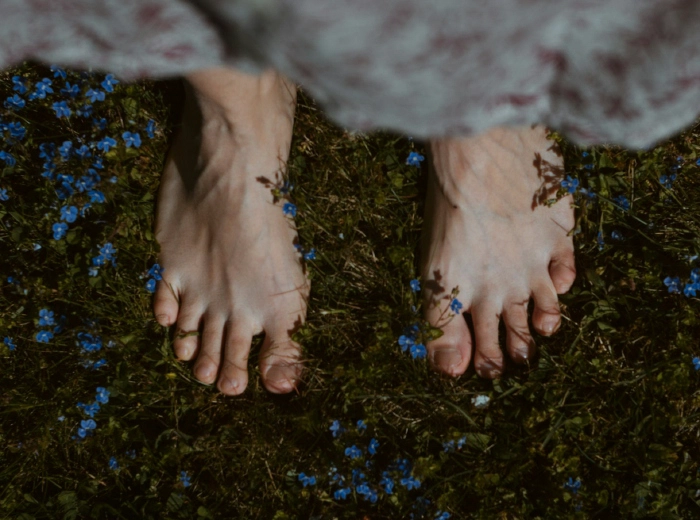
Grass
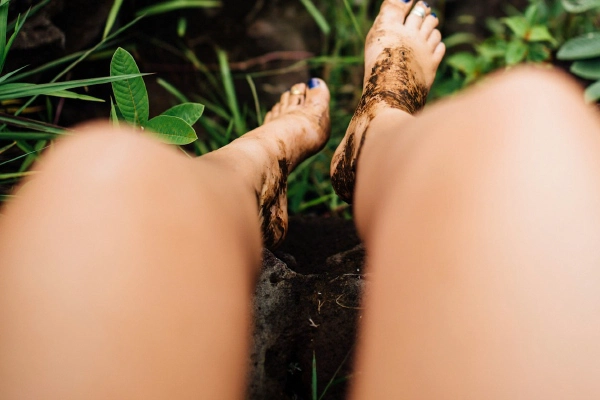
Bare Earth and Soil
Sand and Beach
River Pebbles and Smooth Stones
Forest Floor
What actually happens when your feet touch the earth
There’s a reason natural ground feels different from any indoor surface, even a very good wooden one. The earth carries a mild negative electrical charge. Through modern life, mainly via electronics, synthetic materials, and rubber-soled shoes that insulate you from the ground, the body tends to accumulate a positive charge imbalance. Bare skin on earth creates an electron exchange that researchers have linked to reduced inflammation markers, lower cortisol, better sleep quality, and measurable changes in the nervous system’s stress response.
The science on this is real but still developing. The important note for natural terrain specifically: not all surfaces conduct equally. Damp earth and morning-wet grass transmit electrons far better than dry sand or stone. Wet forest soil is among the most conductive natural surfaces available to most people. That morning dew on the lawn isn’t just beautiful, it’s a better conductor.
Beyond the electrical dimension, natural ground engages texture, temperature, smell, even sound in a way that indoor barefoot simply can’t replicate. Your nervous system runs on sensory input. Natural ground provides more of it than almost anything else.
For everything the research says, head to the full earthing guide.
Your first steps on natural ground
If you’ve been barefoot indoors regularly, you’ve built a useful base. Natural ground takes a different kind of adaptation. Here’s how to make it work:
- Start with soft, even grass: Find a park, a garden, a strip of lawn. Remove footwear. Stand still for a moment and let your feet feel the surface before you walk anywhere. This takes about thirty seconds and shifts something in how your body reads what follows
- Go slowly at first: Natural ground asks more of your feet than smooth floors. Five to fifteen minutes is plenty to start. Your intrinsic muscles, tendons, and plantar fascia all need time to adapt. Too much too quickly is how you end up sore and put off the whole thing
- Actually pay attention: Walking barefoot on natural ground while listening to a podcast is nice. Walking barefoot on natural ground with your full attention on what you’re feeling is something else entirely. What’s the temperature of the soil? Where are the firm spots? What does the transition from grass to earth feel like? Your feet have 200,000 nerve endings waiting to report back. Let them
- Progress through surfaces: Once grass feels easy, try a gravel path. Try damp soil. Try moss. Try river stones if you have access. Each new surface is its own sensory world
- Try it in the morning: Morning dew on grass, cool soil before the sun has hit it, the air before anyone else is up. It’s a different experience from an afternoon walk, full stop. Try it at least once before you decide it’s not your thing
Natural barefoot terrain in the UK: more accessible than you'd think
The UK is remarkably well-placed for this. The country has some of the most consistently damp, moss-covered, soft-underfoot ground in Europe. British parks are generally spacious, well-maintained, and public. The coastline is extensive and largely free to access. The network of public footpaths and rights of way covers hundreds of thousands of miles. You’re almost certainly within reasonable distance of decent natural barefoot terrain right now.
Urban options
Out-of-city options
For places specifically designed for barefoot walking with varied natural surfaces, the barefoot parks guide covers Europe’s dedicated sensory trails. When you’re ready to take natural terrain walking further into proper hiking territory, the barefoot hiking guide has everything you need.
Barefoot on Natural Ground FAQs
Find some earth. Take your shoes off.
Everything your feet were designed for is already out there. The sensory complexity, the variable surface demands, the connection to living ground. The next time you’re near a park, a beach, a garden, or a woodland path, take your shoes off for a bit.
No special gear. No programme to follow. Just natural ground and the willingness to actually feel it.
Go deeper:
- Earthing guide: what happens when bare skin meets earth, and what the research actually says
- Walking surfaces: what each surface type does to your feet and how your body responds
- Barefoot parks and sensory trails: places specifically designed for barefoot natural terrain walking across Europe
- Barefoot hiking: when you’re ready to take natural ground walking further on proper trails
- Barefoot benefits: the full picture of what going barefoot does for your health
- Barefoot in the forest: a deeper dive into forest floor barefoot time and why it hits different
- Barefoot mindfulness: how walking barefoot with full attention becomes something close to meditation